


Lia Weiner, the winner of WJC’s 2017 Campus Pitch Competition, held in cooperation with the Consulate General of Israel in New York, believes in dialogue. Here’s why.
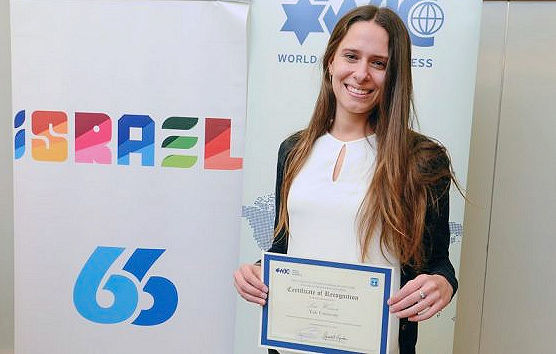 After completing her military service, “and of course the “equally mandatory” South America backpacking trip”, Israel-born Lia begun her studies at Yale where she is a senior in the Ethics, Politics, and Economics major, using the three lenses of the major to look at the Israeli-Palestinian conflict and its resolution.
Lia is the founder of MEREAD at Yale: Middle Eastern Resolution through Education Action and Dialogue, a diverse group comprised of Israelis and Jews from the entire political and religious spectrum, Palestinians and Arabs from Egypt, Jordan, Lebanon, Syria and Saudi Arabia, members of organizations such as Seeds of Peace, Students for Justice in Palestine, Yale Friends of Israel, and many more.
“Operating under the understanding that one day, we will be the people sitting around the negotiation table of the Arab-Israeli conflict, I lead the group in our weekly meetings, in an attempt to create an understanding of the other and to create a different future to for the Israeli-Palestinian conflict,” Lia tells the WJC.
WJC: Congratulations on winning, Lia! What motivated you to participate in the competition?
Lia Weiner: I interned at the Washington Institute for Near East Policy this past summer, and had the great privilege to work with David Makovsky and Ghaith al-Omari. I have been working with them ever since to try to bring them to Yale so they could moderate and lead their mock negotiations workshop here. I thought that a platform like the WJC Campus Pitch Competition would be a wonderful opportunity to both receive funding to make this event happen, but also reach out to students on other college campuses and share ideas with them.
How do you feel about the level of knowledge the average students have about the Middle East and Israel in particular? Do you find it objective?
Students at Yale are generally knowledgeable about the Middle East, but I have sensed over the past few years that there is a real distrust in the way the Middle East and Israel in particular are portrayed, and students are hesitant to listen to one narrative or the other, wishing to hear a balanced view that encapsulates both.
What's the responsibility of Jewish students in this regard?
Jewish students are very active on our campus, and engage in dialogue and share ideas with students who view Israel differently. I believe that so long as we keep communications open and we are talking to one another this campus is a safe place to be openly Jewish, and expressing our views. Having students of diverging opinions engaging with one another prevents the instigation of dehumanization that might happen elsewhere.
ATTENTION STUDENTS!
The Consulate General of Israel in Los Angeles and the World Jewish Congress invite university students in the Greater Los Angeles area to pitch their idea for a campus event, strategy, or initiative that explores a new approach to supporting Israel, combating anti-Semitism, or promoting intercommunity/faith relations. The winning student or group will receive a GRAND PRIZE OF $5,000!
More information at: http://bit.ly/lacampuspitch


