


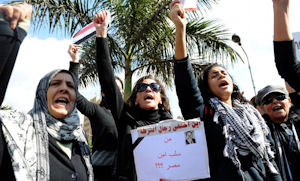
 Egyptian President Hosni Mubarak has instructed his government to start immediate talks with the opposition parties as pressure on him to quit was rising, the ‘al-Arabiya’ television reported. Mubarak told his new prime minister, Ahmed Shafiq, whom he had appointed only last week and whose government he swore in on Monday, to start talking to the opposition and find out their specific demands. On Monday afternoon, more than 100,000 protesters gathered again in Cairo's Tahrir Square, as well as in other Egyptian cities.
Over the weekend, when Egyptian police were largely absent from the streets, thousands of prisoners had managed to escape in a series of mass jailbreaks. Inmates from at least four prisons walked free, among them suspected Islamic extremists and members of the Muslim Brotherhood. On Monday, media reported that police had arrested a number of those who had escaped. Also on Monday, police in Cairo detained six journalists for ‘al-Jazeera’, the Arab TV news network, and confiscated their equipment.
Last week, US President Barack Obama spoke on the phone to Mubarak and urged him not to clamp down on protestors. Secretary of State Clinton said the US wanted to see “an orderly transition” of power. She added: "It is not a question of who retains power. It is: how are we going to respond to the legitimate needs and grievances expressed by the Egyptian people and chart a new path.”
Tony Blair, Middle East peace envoy of the International Quartet and a former British prime minister, told the TV network ‘Sky News’ that the developments in Egypt had "vast implications for the State of Israel, the Palestinians and the peace process." He also said that Egypt had “a very strong Islamist movement through the Muslim Brotherhood ... I think that the people of Egypt will not elect a Muslim Brotherhood government," Blair opined.


