


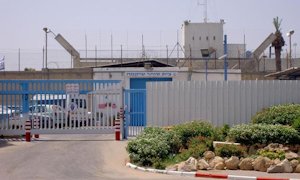
 More than 1,600 Palestinian prisoners have ended a month-long hunger strike following an agreement between Israel and the PLO that will improve conditions in prisons. Palestinian Prisoner Affairs minister Issa Karakeh said prisoner leaders meeting in Ashkelon Prison (pictured), in southern Israel, had reviewed and signed the pact. Israel’s Shin Bet security agency said that the prisoners had pledged to “completely halt terrorist activity” inside the jails, including recruitment, guidance and finance for attacks.
Two of the prisoners, Bilal Diab and Thaer Halahleh, stopped eating 75 days ago. Most of the other prisoners began their hunger strike on 17 April. Diab and Halahleh, of the Islamic Jihad group, are among more than 300 Palestinian administrative detainees, jailed in a practice first deployed by British mandatory authorities before Israel’s creation. Administrative detention gives a military judge the power to detain without charge or trial for renewable periods of six months, based on secret evidence.
Israel argues that the practice is needed for security and to prevent the exposure of its network of Palestinian informants. However, the hunger strike has prompted some Israelis to reconsider, with Public Security Minister Yitzhak Aharonovich saying recently that the practice was being used too frequently.
 According to Monday’s deal, Israel will ensure that the sentences of serving administrative detainees will not be extended unless there is new evidence against them. The government also agreed that relatives of prisoners from the Gaza Strip would be allowed to visit them for the first time since 2007, when visits were discontinued in response to Hamas’s takeover of strip. Israel also agreed to return prisoners held in solitary confinement to the general wings.
In an official announcement, the Israeli government said it hoped the prisoner agreement would encourage Palestinian President Mahmoud Abbas to return to peace negotiations, which he has shunned because of Israel’s refusal to halt settlement activity in the West Bank. “We hope this gesture will serve to build confidence between the parties and further peace,” Jerusalem said, adding that it would "cancel its commitment regarding solitary confinement and family visits” should Palestinian detainees restart their hunger strike.
Tony Blair, the special envoy for the International Quartet for the Middle East and former British prime minister, welcomed the agreement. He had expressed concern last Sunday over the deteriorating health of the hunger strikers.


