


Following a vote by the Israeli Cabinet in favor of the release of 104 Palestinian prisoners, US Secretary of State John Kerry announced on Sunday that Israelis and Palestinians would meet in Washington later this week to relaunch direct peace talks. Israeli Justice Minister Tzipi Livni was expected to begin discussions with chief Palestinian negotiator Saeb Erekat as early as Monday evening.
A spokesman for Palestinian Authority President Mahmoud Abbas confirmed that he had accepted Kerry's invitation to send Erekat to participate in what the State Department described as a preliminary meeting to establish a "procedural work plan" for negotiations in coming months. "I welcome the Israel government's decision," said Erekat. "Now we should focus on the opportunity the United States is providing for us and make sure we make every possible effort to reach our goals of creating two states."
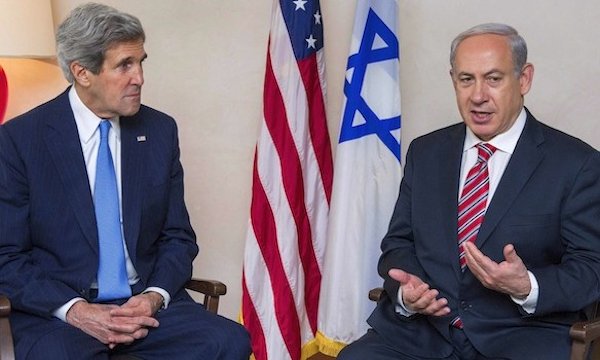 However, Palestinian officials cautioned that some outstanding issues must be clarified before full-fledged negotiations can resume. Hanan Ashrawi, a Palestinian spokeswoman, said the upcoming talks are being held under more difficult conditions than previous negotiations. She cited the Palestinian political split, with Western-backed moderates and Islamic militants running rival governments, and the more hawkish positions of Israel’s prime minister, Benjamin Netanyahu, compared to his predecessor Ehud Olmert. “But I think there is a recognition of the urgency,” Ashrawi said. “If we don’t move fast and decisively, things could fall apart.”
Kerry, who had made the resumption of direct Israeli-Palestinian talks one of his top priorities, thanked Netanyahu and Abbas for their cooperation. "Both leaders have demonstrated a willingness to make difficult decisions that have been instrumental in getting to this point," he said in a statement issued on Sunday evening, adding: "We are grateful for their leadership." However, Kerry's carefully worded statement offered no details of the framework for the resumption of the talks that broke down five years ago.
Netanyahu had to work much harder than he anticipated to lobby his coalition partners to approve the prisoner release, which Palestinians demanded in exchange for returning to the negotiating table. The vote was delayed by several hours on Sunday as the prime minister pressured reluctant Cabinet members to support the measure, which will set free dozens of Palestinians convicted by Israel in the 1980s and 1990s of terrorist attacks against Israelis. Thirteen of Netanyahu's 22 Cabinet members voted in favor with seven opposed and two abstentions.
Outside the prime minister's office, more than 200 protesters, including family members of terrorist-attack victims, carried pictures of loved ones as they denounced Netanyahu for succumbing to pressure from Palestinians and the United States. Some held up hands covered in fake blood.
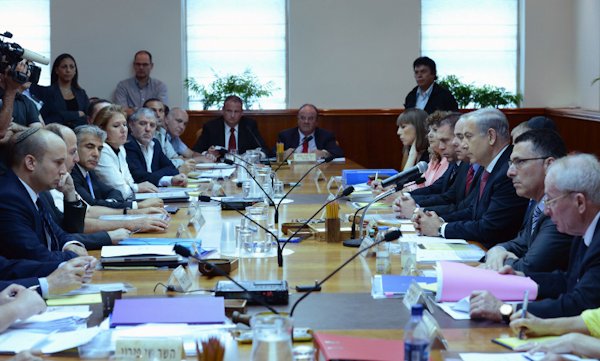 "This moment is not easy for me," Netanyahu said after the vote. "It is not easy for the ministers. It is not easy especially for the families, the bereaved families, whose heart I understand. But there are moments in which tough decisions must be made for the good of the country and this is one of those moments." He said the regional unrest caused by the 'Arab Spring' was pushing Israel to settle its differences with Palestinians. "I believe that resuming the diplomatic process at this time is important for the state of Israel both in order to try to bring about an end to the conflict and, given the complex reality in our region, especially the security challenges from Syria and Iran," Netanyahu said.
The names of the 104 prisoners have apparently not been determined. Netanyahu formed a committee of Cabinet members, which he will lead, to identify the prisoners to be released and set the timetable. Israeli Science Minister Yaakov Peri told the Israeli news site 'Ynet' that no Arab Israelis would be included without further Cabinet approval. Prisoners are expected to be set free in four stages over the next nine months, but releases will be contingent upon progress made at the negotiating table, Netanyahu said.
Israel to hold referendum in case of peace agreement
Earlier on Sunday, the Israeli prime minister won the backing of his Cabinet for a draft bill that would require — if passed by the Knesset — that any final peace deal be approved by voters in a referendum. The measure was seen as an effort to make right-wing lawmakers more receptive to the prisoner release.
The referendum bill — which was pushed by Jewish Home party leader Naftali Bennett — will be introduced as a Basic Law, giving it constitutional rank. Israel has no constitution, but Basic Laws are intended to secure basic rights and trump other laws.


