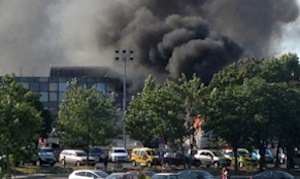
 Bulgaria has turned over to Europol the names of the two Hezbollah-linked suspects in the bombing of an Israeli tour bus in Burgas. The suspects' names have not been made public, however, and the identity of the bomber, who died in the blast, has not been firmly established. Bulgarian Interior Minister Tsvetan Tsvetanov in a meeting updated Europol Director Rob Wainwright on the investigation, the Interior Ministry in Sofia said in a statement. It added that the names of the suspects were included on the database of the European Union's law enforcement agency to determine whether they have resided in any EU country and if other EU agencies have any information on them.
The Bulgarian government last week implicated the suspects in the July attack on a bus full of Israeli tourists. Tsvetanov also said that the Lebanon-based Hezbollah financed the bomb attack, which killed five Israeli tourists and their Bulgarian driver.
Bulgaria reportedly also has turned over a report on the bombing to Lebanon and asked the country's authorities to arrest and extradite the suspects, who they believe are living in Lebanon, to Bulgaria.
Both Hezbollah and Iran have denied involvement in the attack.
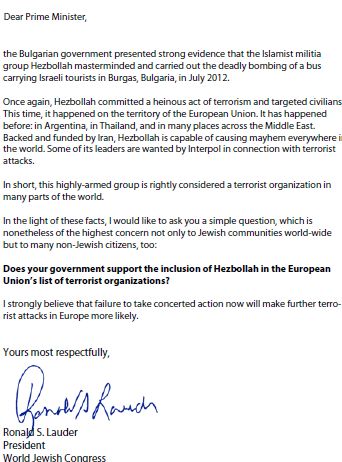
Following the Burgas attack last July, the World Jewish Congress and other Jewish groups have urged the European Union to include Hezbollah on its list of terrorist groups. Last week, WJC President Ronald S. Lauder wrote a letter (see below) to all 27 EU heads of government, asking them to take this measure to prevent further attacks on European soil.
In New York, Israel's UN envoy Ron Prosor also urged EU leaders to take action. "Calling Hezbollah a charity is like calling al-Qaida an urban-planning organization because of its desire to level tall buildings,” he told a UN Security Council open debate on the protection of civilians in armed conflict. Prosor denounced the fact that Hezbollah is still not on the list of EU terror organizations.“The terrorist attack demonstrated once again that the organization's activities are not limited to the Middle East and that its fingerprints can be found on five continents - from Kenya to Argentina, Thailand, India, Europe and the United States. Hezbollah's sole purpose - its raison d'etre - is to commit terrorist acts both inside and outside the Middle East," the Israeli ambassador said. He stressed that the only difference between the military and political wings of Hezbollah "is that the political wing negotiates the sum of drug cartel money that the military wing later uses to purchase weaponry." Prosor: "It does not take a Nobel Peace Prize laureate to realize that we are not exactly dealing with a selfless humanitarian organization."