


After four days of talks, the foreign ministers of the United States, Britain, China, France, Germany and Russia and the European Union announced that they had agreed on a six-month deal aimed at giving Iran limited sanctions relief in return for temporary restrictions on its nuclear program.
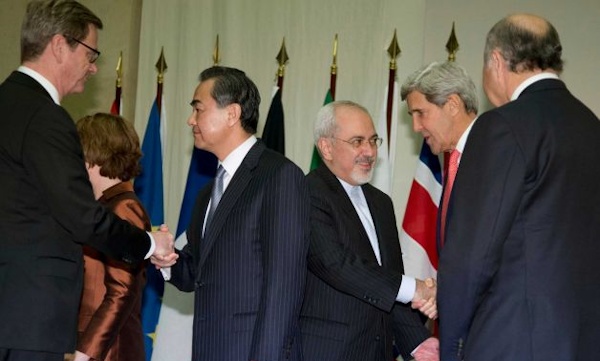 European Union foreign policy chief Catherine Ashton, who has been co-ordinating talks with Iran on behalf of the major powers, said it created time and space for talks aimed at reaching a comprehensive solution to the dispute. "This is only a first step," Iranian Foreign minister Mohammad Zarif told a press conference. "We need to start moving in the direction of restoring confidence, a direction in which we have managed to move against in the past."
"Iran, like any nation, should be able to access peaceful nuclear energy, but because of its record of violating its obligations, Iran must accept strict limitations on its nuclear program that make it impossible to develop a nuclear weapon," US President Obama said in a statement at the White House. "The burden is on Iran to prove to the world that its nuclear program will be exclusively for peaceful purposes."
The deal, described by Obama as "an important first step toward a comprehensive solution," is intended to open the way for what is likely to prove even tougher bargaining to reach a comprehensive agreement. US Secretary of State John F. Kerry, speaking in Geneva, said that limiting Iran's nuclear program would expand the time Tehran would need to reach a nuclear weapons capability. "It will make our ally Israel safer," he told a press conference.
World Jewish Congress: 'Iran's promises are not worth the paper they are written on'
World Jewish Congress (WJC) President Ronald S. Lauder voice skepticism about the agreement: "Iran must be judged by its actions, not its words and promises, because they are not worth the paper they are written on. Nothing in the deceptive behavior of Iran and its leaders in recent years should make the world believe that they will honor this agreement.”
Lauder added that the WJC welcomed the preparedness of US Congress leaders to support a strengthening of Iran sanctions.
The Israeli government in Jerusalem strongly rejected the agreement. In remarks before his weekly Cabinet meeting on Sunday, Israeli Prime Minister Benjamin Netanyahu said, "What was achieved last night in Geneva is not an historic agreement, but an historic mistake.” He added: “Today the world has become a much more dangerous place because the most dangerous regime in the world has taken a significant step toward attaining the most dangerous weapon in the world."
Full text of the agreement
Source: CNN
Preamble
The goal for these negotiations is to reach a mutually-agreed long-term comprehensive solution that would ensure Iranˈs nuclear program will be exclusively peaceful. Iran reaffirms that under no circumstances will Iran ever seek or develop any nuclear weapons. This comprehensive solution would build on these initial measures and result in a final step for a period to be agreed upon and the resolution of concerns. This comprehensive solution would enable Iran to fully enjoy its right to nuclear energy for peaceful purposes under the relevant articles of the NPT in conformity with its obligations therein. This comprehensive solution would involve a mutually defined enrichment program with practical limits and transparency measures to ensure the peaceful nature of the program. This comprehensive solution would constitute an integrated whole where nothing is agreed until everything is agreed. This comprehensive solution would involve a reciprocal, step-by step process, and would produce the comprehensive lifting of all UN Security Council sanctions, as well as multilateral and national sanctions related to Iranˈs nuclear program.
There would be additional steps in between the initial measures and the final step, including, among other things, addressing the UN Security Council resolutions, with a view toward bringing to a satisfactory conclusion the UN Security Councilˈs consideration of this matter.
The E3+3 and Iran will be responsible for conclusion and implementation of mutual near-term measures and the comprehensive solution in good faith. A Joint Commission of E3/EU+3 and Iran will be established to monitor the implementation of the near-term measures and address issues that may arise, with the IAEA responsible for verification of nuclear-related measures. The Joint Commission will work with the IAEA to facilitate resolution of past and present issues of concern.
Elements of a first step
The first step would be time-bound, with a duration of 6 months, and renewable by mutual consent, during which all parties will work to maintain a constructive atmosphere for negotiations in good faith.
Iran would undertake the following voluntary measures:
• From the existing uranium enriched to 20%, retain half as working stock of 20% oxide for fabrication of fuel for the TRR. Dilute the remaining 20% UF6 to no more than 5%. No reconversion line.
• Iran announces that it will not enrich uranium over 5% for the duration of the 6 months.
• Iran announces that it will not make any further advances of its activities at the Natanz Fuel Enrichment Plant, Fordow, or the Arak reactor, designated by the IAEA as IR-40.
• Beginning when the line for conversion of UF6 enriched up to 5% to UO2 is ready, Iran has decided to convert to oxide UF6 newly enriched up to 5% during the 6 month period, as provided in the operational schedule of the conversion plant declared to the IAEA.
• No new locations for the enrichment.
• Iran will continue its safeguarded R&D practices, including its current enrichment R&D practices, which are not designed for accumulation of the enriched uranium.
• No reprocessing or construction of a facility capable of reprocessing.
• Enhanced monitoring:
- Provision of specified information to the IAEA, including information on Iranˈs plans for nuclear facilities, a description of each building on each nuclear site, a description of the scale of operations for each location engaged in specified nuclear activities, information on uranium mines and mills, and information on source material. This information would be provided within three months of the adoption of these measures.
- Submission of an updated DIQ for the reactor at Arak, designated by the IAEA as the IR-40, to the IAEA.
- Steps to agree with the IAEA on conclusion of the Safeguards Approach for the reactor at Arak, designated by the IAEA as the IR-40.
- Daily IAEA inspector access when inspectors are not present for the purpose of Design Information Verification, Interim Inventory Verification, Physical Inventory Verification, and unannounced inspections, for the purpose of access to offline surveillance records, at Fordow and Natanz.
- IAEA inspector managed access to: centrifuge assembly workshops ; centrifuge rotor production workshops and storage facilities; and uranium mines and mills.
In return, the E3/EU+3 would undertake the following voluntary measures:
• Pause efforts to further reduce Iranˈs crude oil sales, enabling Iranˈs current customers to purchase their current average amounts of crude oil. Enable the repatriation of an agreed amount of revenue held abroad. For such oil sales, suspend the EU and U.S. sanctions on associated insurance and transportation services.
• Suspend U.S. and EU sanctions on: Iranˈs petrochemical exports, as well as sanctions on associated services. Gold and precious metals, as well as sanctions on associated services.
• Suspend U.S. sanctions on Iranˈs auto industry, as well as sanctions on associated services.
• License the supply and installation in Iran of spare parts for safety of flight for Iranian civil aviation and associated services. License safety related inspections and repairs in Iran as well as associated services.
• No new nuclear-related UN Security Council sanctions.
• No new EU nuclear-related sanctions.
• The U.S. Administration, acting consistent with the respective roles of the President and the Congress, will refrain from imposing new nuclear-related sanctions.
• Establish a financial channel to facilitate humanitarian trade for Iran's domestic needs using Iranian oil revenues held abroad. Humanitarian trade would be defined as transactions involving food and agricultural products, medicine, medical devices, and medical expenses incurred abroad. This channel would involve specified foreign banks and non-designated Iranian banks to be defined when establishing the channel. This channel could also enable: a- transactions required to pay Iran's UN obligations; and, b- direct tuition payments to universities and colleges for Iranian students studying abroad, up to an agreed amount for the six month period.
• Increase the EU authorization thresholds for transactions for non-sanctioned trade to an agreed amount.
Elements of the final step of a comprehensive solution
The final step of a comprehensive solution, which the parties aim to conclude negotiating and commence implementing no more than one year after the adoption of this document, would:
• Have a specified long-term duration to be agreed upon.
• Reflect the rights and obligations of parties to the NPT and IAEA Safeguards Agreements.
• Comprehensively lift UN Security Council, multilateral and national nuclear-related sanctions, including steps on access in areas of trade, technology, finance, and energy, on a schedule to be agreed upon.
• Involve a mutually defined enrichment program with mutually agreed parameters consistent with practical needs, with agreed limits on scope and level of enrichment activities, capacity, where it is carried out, and stocks of enriched uranium, for a period to be agreed upon.
• Fully resolve concerns related to the reactor at Arak, designated by the IAEA as the IR-40. No reprocessing or construction of a facility capable of reprocessing.
• Fully implement the agreed transparency measures and enhanced monitoring. Ratify and implement the Additional Protocol, consistent with the respective roles of the President and the Majlis (Iranian parliament).
• Include international civil nuclear cooperation, including among others, on acquiring modern light water power and research reactors and associated equipment, and the supply of modern nuclear fuel as well as agreed R&D practices.
Following successful implementation of the final step of the comprehensive solution for its full duration, the Iranian nuclear program will be treated in the same manner as that of any non-nuclear weapon state party to the NPT.


