


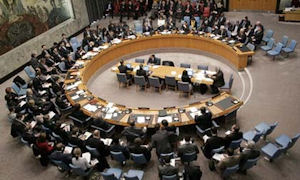
 All members of the United Nations Security Council with the exception of the United States have issued public statements strongly condemning Israeli settlement building in the West Bank and eastern Jerusalem. The UN secretary general and the ambassadors of 14 of the council’s 15 members read out public statements outside the council chamber. They did not seek formal action inside since a condemnation of Israel would have likely been blocked by the United States, one of the five veto-wielding powers on the Security Council.
However, the State Department in Washington also accused Israel of "a pattern of provocative action". Spokeswoman Victoria Nuland said settlement activity put the goal of peace "further at risk".
The four European member states currently serving on the Security Council - France, Germany, Portugal and the UK - issued a statement saying they were "extremely concerned" by Israel's intentions to build more settlements. The coordinated EU statement, which was posted Wednesday on the German UN Delegation’s website, says: “Israel's announcements to accelerate the construction of settlements send a negative message and are undermining faith in its willingness to negotiate.” It adds: “The viability of the two-state solution that is key for Israel's long-term security is threatened by the systematic expansion of settlements. Settlements are illegal under international law and detrimental to any international efforts to restart peace negotiations and secure a two-state solution. All settlement activity, including in East Jerusalem, must cease immediately.”
Russia's UN envoy Vitaly Churkin called upon Israel to end its settlement activities and to "show restraint and refrain from unilateral actions". He declared: "Of special concern are the settlement activities of Israel in the occupied Palestinian territories including east Jerusalem and the decision to suspend transfer to tax and duty revenues for the Palestinian National Authority."
 Israel’s envoy to the UN, Ron Prosor, insisted that settlements were not the major hurdle to peace. He stressed that the latest announcements were part of a bureaucratic process known as "planning and zoning". He repeated Israeli demands that Palestinians return to peace talks without preconditions.
For his part, Prime Minister Benjamin Netanyahu said building would continue. "We are going to build in Jerusalem for all its residents," he said. "This is something that has been done by all previous governments and this is something that my government will continue to do."
On Wednesday, Jerusalem's planning committee approved 2,610 homes in a new settlement in the eastern part of the city called Givat Hamatos. It is the first to be built in the area since 1997. Meanwhile, tenders have been announced for several settlements in the West Bank for a total of 1,000 new homes.


